

Saving this page to a PDF file.
Chrome
Step 1: Click the "Print this page" button. Alternatively, press Ctrl + P (on Mac, use Cmd + P)
Step 2: In the resulting pop-up window, click the Down Arrow to the right of Destination and select Save As PDF in the drop-down menu. You can also optionally choose to hide 'Headers and Footers' with a checkbox.
IE/Edge
Step 1: Click the "Print this page" button. Alternatively, press Ctrl + P (on Mac, use Cmd + P)
Step 2: On the following dialog, under Printer, choose 'Microsoft Print to PDF'
Click 'Print' and you have saved your webpage to a PDF file.
Meningitis
Meningitis is an infection of the protective membranes that surround the brain and spinal cord (meninges). It can affect anyone but is most common in babies, young children, teenagers and young adults.
Symptoms of meningitis, septicaemia and meningococcal disease include:
- headache
- a stiff neck
- a dislike of bright lights
- a high temperature
- cold hands and feet
- vomiting
- confusion
- breathing quickly
- muscle and joint pain
- pale, mottled or blotchy skin
- spots or a rash
- being very sleepy or difficult to wake
- fits (seizures)
There are two types of meningitis:
- Bacterial: a serious infection that requires urgent treatment with antibiotics. Can result in long term complications.
- Viral: generally a less serious infection which doesn't often result in long term complications. Does not need treatment with antibiotics.
Unfortunately, without tests, it can be extremely difficult to distinguish the two.
However, following the introduction over the past few years of routine vaccinations for babies against infections such a meningococcus, pneumococcus and haemophilus, the rates of bacterial meningitis in children have more than halved. As a result, the number of children affected each year by bacterial meningitis in the UK is now less than 1 in 10,000.
When should you worry?
If your child has any of the following:
-
Breathing very fast, too breathless to talk, eat or drink
-
Working hard to breathe, drawing in of the muscles below the ribs, or noisy breathing (grunting)
-
Breathing that stops or pauses
-
Is pale, blue, mottled or feels unusually cold to touch
-
Difficult to wake up, very sleepy or confused
-
Weak, high-pitched cry or can’t be settled
-
Has a fit (seizure
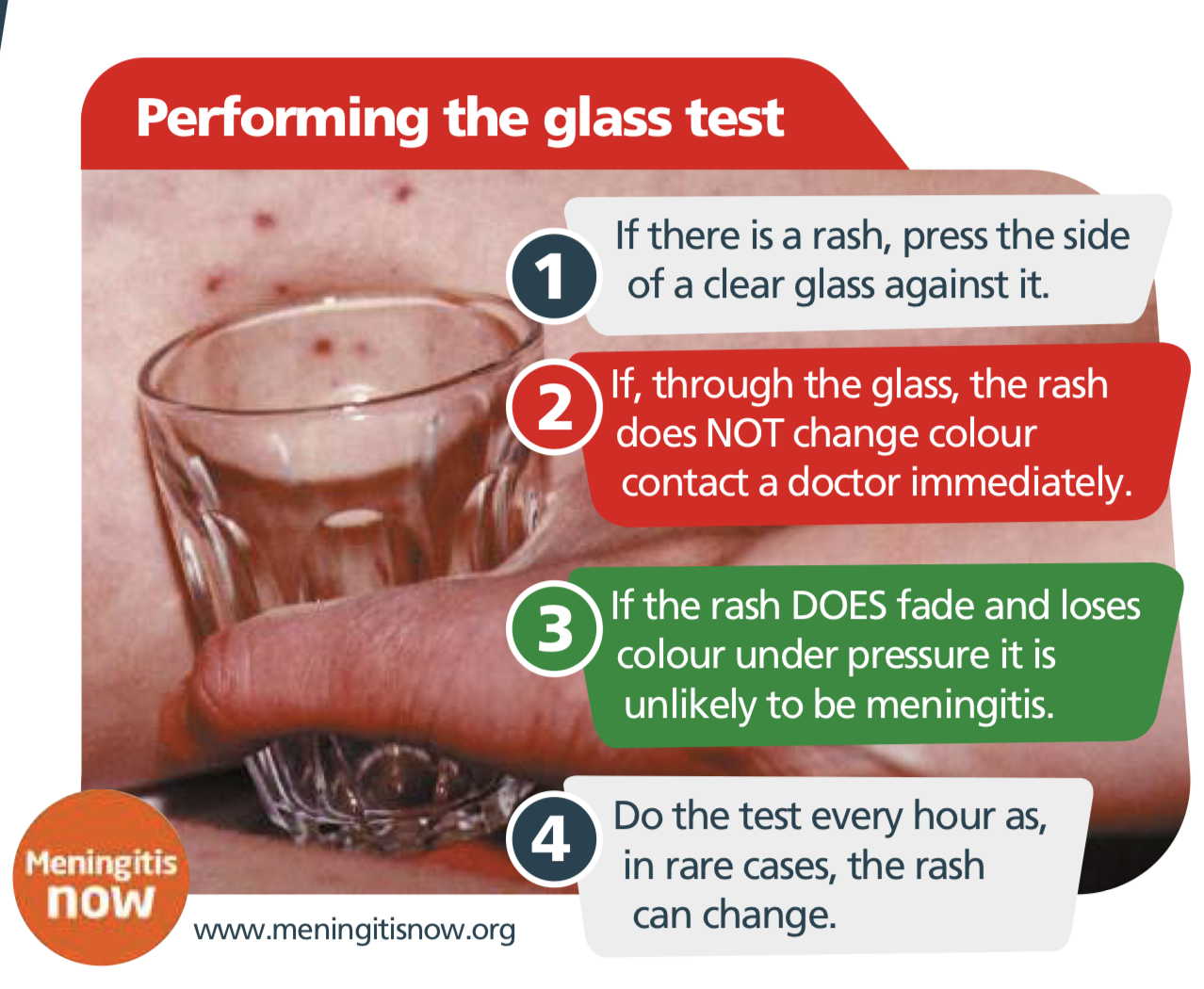
- Develops a rash that does not disappear with pressure (the Glass Test)
- Is under 3 months of age with a temperature of more than 38°C or under 36°C (unless fever in the 48 hours following vaccinations and no other red or amber features)
You need urgent help.
Go to the nearest Hospital Accident and Emergency Department or phone 999
If your child has any of the following:
-
A severe headache and neck stiffness/pain
-
discomfort with bright lights (photophobia)
-
Breathing a bit faster than normal or working a bit harder to breathe
-
Dry skin, lips or tongue
-
Not had a wee or wet nappy in last 8 hours
-
Poor feeding in babies (less than half of their usual amount)
-
Irritable (Unable to settle them with toys, TV, food or hugs even after their fever has come down)
- Is 3 to 6 months of age with a temperature of 39°C or above (but fever is common in babies up to 2 days after they receive vaccinations)
- Continues to have a fever of 38°C or above for more than 5 days or shivering with fever (rigors)
- Temperature less than 36°C in those over 3 months
- Is getting worse or if you are worried
You need to contact a doctor or nurse today
Please ring your GP surgery or call NHS 111
If symptoms persist for 4 hours or more and you have not been able to speak to either a member of staff from your GP practice or to NHS 111 staff, recheck that your child has not developed any red features
If none of the above features are present
Watch them closely for any change and look out for any red or amber symptoms.
Additional advice is also available to young families for coping with crying of well babies.
If your child has a long term condition or disability and you are worried please contact your regular team or follow any plans that they have given you.
Self care
Continue providing your child’s care at home. If you are still concerned about your child, call NHS 111 or contact your local community pharmacist
This guidance has been reviewed and adapted by healthcare professionals across West Yorkshire with consent from the Hampshire development groups.
What should you do?
- Only a tiny proportion of children who have a fever and are miserable have bacterial meningitis. Look closely at the symptoms in the red and amber boxes above.
- Children should be assessed by a medical professional if you are worried.
- If your child has none of the symptoms in the red and amber boxes, please see advice on treating fever.
If a rash appears, do the glass test.
Where should you seek help?
- If it is non urgent (rated in green above), speak to your local pharmacist
- If your child has any of the above features (rated in amber above), urgently contact your GP.
- For an urgent out of hours GP appointment, call NHS 111.
- You should only call 999 or go your nearest A&E department in critical or life threatening situations. (rated in red above)
You can treat your child's very minor illnesses and injuries at home.
Some illnesses can be treated in your own home with support and advice from the services listed when required, using the recommended medicines and getting plenty of rest.
Sound advice
Children can recover from illness quickly but also can become more poorly quickly; it is important to seek further advice if a child's condition gets worse.
For information on common childhood illnesses go to What is wrong with my child?
You can treat your child's very minor illnesses and injuries at home.
Some illnesses can be treated in your own home with support and advice from the services listed when required, using the recommended medicines and getting plenty of rest.
Sound advice
Children can recover from illness quickly but also can become more poorly quickly; it is important to seek further advice if a child's condition gets worse.
For information on common childhood illnesses go to What is wrong with my child?
All community pharmacies across England are required to be Healthy Living Pharmacies. This means that they are able to offer advice on a range of healthy living matters which includes eating a healthy diet. They can provide information leaflets and give parents, carers and young people more information about other organisations that might also be able to help.
Pharmacists are experts in many aspects of healthcare, and can offer advice on a wide range of long-term conditions and common illnesses such as coughs, colds and stomach upsets. You don’t need an appointment, and many have private consultation areas. Your pharmacist will say if you need further medical attention.
Sound advice
- Visit a pharmacy if your child is ill, but does not need to see a GP.
- Remember that if your child's condition gets worse, you should seek further medical advice immediately.
- Help your child to understand. Watch this video with them about going to the pharmacy.
For information on common childhood illnesses go to What is wrong with my child?
All community pharmacies across England are required to be Healthy Living Pharmacies. This means that they are able to offer advice on a range of healthy living matters which includes eating a healthy diet. They can provide information leaflets and give parents, carers and young people more information about other organisations that might also be able to help.
Pharmacists are experts in many aspects of healthcare, and can offer advice on a wide range of long-term conditions and common illnesses such as coughs, colds and stomach upsets. You don’t need an appointment, and many have private consultation areas. Your pharmacist will say if you need further medical attention.
Sound advice
- Visit a pharmacy if your child is ill, but does not need to see a GP.
- Remember that if your child's condition gets worse, you should seek further medical advice immediately.
- Help your child to understand. Watch this video with them about going to the pharmacy.
For information on common childhood illnesses go to What is wrong with my child?
Health visitors are nurses or midwives who are passionate about promoting healthy lifestyles and preventing illness through the delivery of the Healthy Child Programme. They work with you through your pregnancy up until your child is ready to start school.
Health Visitors can also make referrals for you to other health professionals for example hearing or vision concerns, or to the Community Paediatricians, or the child and adolescent mental health services.
Contact your local Health Visiting Team:
Bradford Health Visitors or call - 01274 221223
Wakefield Health Visitors or call - 0300 373 0944
Craven Health Visitors or call - 01423 544265
Leeds Health Visitors or call - 0113 843 5683
Calderdale Health Visitors or call - 030 0304 5555 (local rate number)
Kirklees Health Visitors or call - 030 0304 5555 (local rate number)
Sound advice
Health visitors also provide advice, support and guidance in caring for your child, including:
- Breastfeeding, weaning and healthy eating
- Exercise, hygiene and safety
- Your child’s growth and development
- Emotional health and wellbeing, including postnatal depression
- Safety in the home
- Stopping smoking
- Contraception and sexual health
- Sleep and behaviour management (including temper tantrums!)
- Toilet training
- Minor illnesses
For more information about what Health Visitors do: What does a health visitor do?
Health visitors are nurses or midwives who are passionate about promoting healthy lifestyles and preventing illness through the delivery of the Healthy Child Programme. They work with you through your pregnancy up until your child is ready to start school.
Health Visitors can also make referrals for you to other health professionals for example hearing or vision concerns, or to the Community Paediatricians, or the child and adolescent mental health services.
Contact your local Health Visiting Team:
Bradford Health Visitors or call - 01274 221223
Wakefield Health Visitors or call - 0300 373 0944
Craven Health Visitors or call - 01423 544265
Leeds Health Visitors or call - 0113 843 5683
Calderdale Health Visitors or call - 030 0304 5555 (local rate number)
Kirklees Health Visitors or call - 030 0304 5555 (local rate number)
Sound advice
Health visitors also provide advice, support and guidance in caring for your child, including:
- Breastfeeding, weaning and healthy eating
- Exercise, hygiene and safety
- Your child’s growth and development
- Emotional health and wellbeing, including postnatal depression
- Safety in the home
- Stopping smoking
- Contraception and sexual health
- Sleep and behaviour management (including temper tantrums!)
- Toilet training
- Minor illnesses
For more information about what Health Visitors do: What does a health visitor do?
School nurses care for children and young people, aged 5 to19, and their families, to ensure their health needs are supported within their school and community. They work closely with education staff and other agencies to support parents, carers and the children and young people, with physical and, or emotional health needs.
Contacting the School Nurse
Primary and secondary schools have an allocated school nurse. Phone your child’s school to ask for the contact details of your named school nurse.
There is also a specialist nurse who works with families who choose to educate their children at home.
Contact your local school nursing team:
Bradford School Nurses 01274 221203
Wakefield School Nurses (0 to 19 service) 0300 373 0944 (local rate number)
Leeds School Nurses 0113 843 5683
Calderdale School Nurses 030 3330 9974 (local rate number)
Kirklees School Nurses 0300 304 5555 (local rate number)
Sound Advice
Before your child starts school your health visitor will meet with the school nursing team to transfer their care to the school nursing service. The school nursing team consists of a school nursing lead, specialist public health practitioners and school health staff nurses.
They all have a role in preventing disease and promoting health and wellbeing, by:
- encouraging healthier lifestyles
- offering immunisations
- giving information, advice and support to children, young people and their families
- supporting children with complex health needs
Each member of the team has links with many other professionals who also work with children including community paediatricians, child and adolescent mental health teams, health visitors and speech and language therapists. The school health nursing service also forms part of the multi-agency services for children, young people and families where there are child protection or safeguarding issues.
School nurses care for children and young people, aged 5 to19, and their families, to ensure their health needs are supported within their school and community. They work closely with education staff and other agencies to support parents, carers and the children and young people, with physical and, or emotional health needs.
Contacting the School Nurse
Primary and secondary schools have an allocated school nurse. Phone your child’s school to ask for the contact details of your named school nurse.
There is also a specialist nurse who works with families who choose to educate their children at home.
Contact your local school nursing team:
Bradford School Nurses 01274 221203
Wakefield School Nurses (0 to 19 service) 0300 373 0944 (local rate number)
Leeds School Nurses 0113 843 5683
Calderdale School Nurses 030 3330 9974 (local rate number)
Kirklees School Nurses 0300 304 5555 (local rate number)
Sound Advice
Before your child starts school your health visitor will meet with the school nursing team to transfer their care to the school nursing service. The school nursing team consists of a school nursing lead, specialist public health practitioners and school health staff nurses.
They all have a role in preventing disease and promoting health and wellbeing, by:
- encouraging healthier lifestyles
- offering immunisations
- giving information, advice and support to children, young people and their families
- supporting children with complex health needs
Each member of the team has links with many other professionals who also work with children including community paediatricians, child and adolescent mental health teams, health visitors and speech and language therapists. The school health nursing service also forms part of the multi-agency services for children, young people and families where there are child protection or safeguarding issues.
GPs assess, treat and manage a whole range of health problems. They also provide health education, give vaccinations and carry out simple surgical procedures. Your GP will arrange a referral to a hospital specialist should you need it.
All children should be registered with a GP. Anyone in England can register for free with a GP surgery. You do not need proof of address or immigration status, ID or an NHS number.
Sound advice
You have a choice of service:
- Doctors/GPs can treat many illnesses that do not warrant a visit to A&E.
- Help your child to understand. Watch this video with them about visiting the GP or going to a walk in centre
For information on common childhood illnesses go to What is wrong with my child?
GPs assess, treat and manage a whole range of health problems. They also provide health education, give vaccinations and carry out simple surgical procedures. Your GP will arrange a referral to a hospital specialist should you need it.
All children should be registered with a GP. Anyone in England can register for free with a GP surgery. You do not need proof of address or immigration status, ID or an NHS number.
Sound advice
You have a choice of service:
- Doctors/GPs can treat many illnesses that do not warrant a visit to A&E.
- Help your child to understand. Watch this video with them about visiting the GP or going to a walk in centre
For information on common childhood illnesses go to What is wrong with my child?
If you’re not sure which NHS service you need, call 111. An adviser will ask you questions to assess your symptoms and then give you the advice you need, or direct you straightaway to the best service for you in your area.
Please note, the online version of NHS 111 is only recommended for children over the age of 5. If your child is under 5 years old, please phone 111.
NHS 111 can also direct you to your nearest urgent treatment centre (minor injuries unit or walk-in centre).
Sound advice
Use NHS 111 if you are unsure what to do next, have any questions about a condition or treatment or require information about local health services.
For information on common childhood illnesses go to What is wrong with my child?
If you’re not sure which NHS service you need, call 111. An adviser will ask you questions to assess your symptoms and then give you the advice you need, or direct you straightaway to the best service for you in your area.
Please note, the online version of NHS 111 is only recommended for children over the age of 5. If your child is under 5 years old, please phone 111.
NHS 111 can also direct you to your nearest urgent treatment centre (minor injuries unit or walk-in centre).
Sound advice
Use NHS 111 if you are unsure what to do next, have any questions about a condition or treatment or require information about local health services.
For information on common childhood illnesses go to What is wrong with my child?
A&E departments provide vital care for life-threatening emergencies, such as:
- loss of consciousness
- breathing difficulties
- severe bleeding that cannot be stopped
- major trauma such as road traffic collisions
If you’re not sure it’s an emergency, call 111 for advice.
Sound advice
A&E departments provide vital care for life-threatening emergencies, such as:
- loss of consciousness
- breathing difficulties
- severe bleeding that cannot be stopped
- major trauma such as road traffic collisions
If you’re not sure it’s an emergency, call 111 for advice.